Ezekiel 36:24-26, 33-36 | 1 Peter 1:13-16, 22-25
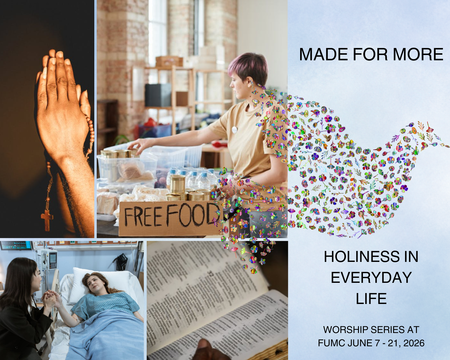
What does it mean to live a holy life? In this first sermon of a three-part series on holiness, we explore one of the most distinctive ideas at the heart of the Wesleyan tradition: that faith is not merely something to think about — it is something to feel, to live, and to breathe. Drawing on John Wesley's vision of practical theology, we discover that holiness is not a doctrine to be mastered but a way of life to be embodied, beginning with the transformation of the heart.
At the center of this message is a powerful prophecy from Ezekiel, who spoke to a people on the edge of devastation and exile. His word to them — and to us — is that even in the midst of ruin, God is actively at work. The restoration God promises is not merely about rebuilding cities and fields. It is about replacing hearts of stone with living hearts. And crucially, this transformation is not something we accomplish on our own. It begins with God's grace reaching into our lives, even when we feel most lost.
From Ezekiel's prophecy, we turn to the letter of First Peter, where the transformed heart is shown to produce a new and powerful kind of love — fervent love. This is not the conditional, self-interested love we so easily default to, but a love drawn from the inexhaustible heart of God. When we love from that place, the boundaries we draw between who deserves our love and who doesn't begin to fall away. This is what John Wesley called being "perfected in love" — not a life free of mistakes, but a life so saturated with God's love that it pours out into everything we do.
Personal holiness, then, is not about trying harder to get right with God. It is about opening ourselves to let God do the transforming work within us — so that the love God pours into our hearts might overflow into our communities, our neighborhoods, and a world in desperate need of it. The changed life and the transformed church are not ends in themselves. They are meant to be a visible, living blessing for the world.
Notes
- John Wesley's definition of a Methodist comes from The Character of a Methodist. I have updated the language in an attempt to be gender inclussive.
- David Benlty Heart translates ἐκτενῶς as fervently