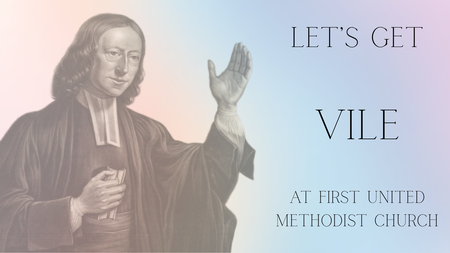
For the first few weeks of this year we are exploring our history. I’ve been using Ashley Boggan’s Wesleyan Vile-tality to help shape this series. Last week we looked at how the Methodists of the 1700s embraced vile things like working with the poor, opposing slavery, and ministry with homosexual men in order to share the Good News. Those Methodists abandoned any sense of respectability in order to go where others wouldn’t and love those others were ignoring. That vile nature started a movement that challenged the ways that the world worked.
It didn’t last long. This week I want to explore some of the ways that our denominational forebearers abandoned that vile nature of the church, choosing instead to focus on things like growing membership, political influence, and chasing after a hope to be seen as a proper and respected faith.
Let’s start with what happened with race relations. If you remember, last week I mentioned that in the 1700s Methodists were at the forefront of the anti-slavery movement. Well, that didn’t last much past Wesley’s death in the late 1700s.
In 1784, At the Christmas Conference in Baltimore that formed the Methodist Episcopal Church, the issue of slavery did come up. The church took a stand that continued the anti-slavery rhetoric of John Wesley. To be a Methodist meant you had to give up the trading and enslavement of human lives. Slave owners who wanted to be Methodists were given a strict timeline to free their slaves and were not allowed into class meetings until they did so.
Within six months of the founding of the Methodist Episcopal Church exceptions were made. It took six months of growth in the American south before Methodists gave up one of their founding principles in order to be more acceptable to slave owners. Methodists gave up something that made them vile for something that would make them popular.
By 1808 when the church was drafting its constitution, it was left up to each individual Annual Conference whether they would accept slave owners into membership or not. Less than 20 years after John Wesley had died, Methodist in America had compromised one of the key concepts of Wesley’s Methodists. Methodists who had once boldly claimed that all people were worthy of God’s love and that all people could seek sanctification and holiness, now acquiesced to the practice of buying and selling human beings.
Congregations were segregated; entire separate Methodist churches were built so that White Methodists didn’t have to worship with Black Methodists. It didn’t take long for breakaway denominations were formed because the Methodists refused to take seriously the sacred worth of all people. By the 1840s the denomination had split over the issue of slavery. When the split was eventually reconciled, it was done so with formalized segregation that we called the Central Jurisdiction, something that was only removed in 1968.
Methodists that had at one point been so open to all people, but especially the under-privilege and marginalized, became mired in racial tensions. Instead of continuing to proclaim the rights and dignity of all people, the church (more often than not) accepted enslavers, practiced segregation, and lost its vile beginnings.
Women didn’t have it any better. Remember last week I talked about Susanna Wesley preaching in her home to the people of the community and Wesley licensing women to preach… yeah, that didn’t last. And it is kind of ironic that we so marginalized women, because without women it is doubtful inf Methodism would have survived in America. Barbara Heck is one the most famous of these women.
Barbara and her cousin Phillip Embury emigrated from Ireland to America in the 1760s. Phillip had been a Methodist preacher, but gave that up after coming to America where he became a carpenter. One day Barbara came home to find Phillip doing something absolutely repulsive… distasteful. Any guesses what he was doing? Playing cards! Barbara gathered the cards up in her apron and threw them into the fire and demanded that Phillip begin a Methodist Class Meeting in America. It is very likely Methodism wouldn’t have taken off in the colonies if Barbara hadn’t forced Phillip’s hand.
Throughout the late 1800s and early 1900s women came forward for ordination in the Methodist Episcopal Church. Time and time again, the church refused to ordain them. Women would rise up as lay delegates to General Conference. Time and time again, the church refused to seat them as delegates.
It took over 100 years between the first attempted ordination of women before women in the Methodist Church were granted full ordination rights in 1956. And if you want to be a little more depressed, it was only in the last year that changes were approved to the church’s constitution that gender and ability were added as protected classes in the definition of what it meant to be an inclusive church (we tried to do it in 2016 and it was voted down).
Perhaps one of the most insidious changes between those vile Methodists of the 1700s and what has come after can be found in how Methodists understand the family. In the 1700s Methodists were often people who had been rejected and disowned by their birth families. Methodists were at the margins of society. Think back to Thomas Blair, the homosexual man that Wesley helped get out of prison. It wasn’t Blair’s family that came to his defense, it was the Methodists who were there when no one else would show up. Methodists would go as far as to call one another “brother and sister” and their leaders were often called “mother and father”
Ashley Boggan writes about the idea of a Methodist family. She says “They began to queer the idea of traditional family by creating their own chosen families who respected them, affirmed them, and held them accountable to a faith acted out in love.”
By the 1870s things had changed. Methodists had begun offering ideas of “proper womanhood” and “proper manhood.” And you can probably imagine what those definitions looked like in the 1870s. Women were to be pious, submissive, and domestic. Men were to be active providers.
By the 1950s Methodists created an annual competition for the Methodist Family of the Year. One family that would be the model for the Methodist nuclear family. Funny enough the winners of Methodist Family of the Year tended to be white, with men who worked, women who stayed home, and multiple children who were active in the church.
During the 1960s two very different expressions of Methodism took root. One that was deeply involved in social activism, civil rights, women’s rights, and gay rights, and another that was very active in maintaining the status-quo. More often than not, the status-quo group has outnumbered the social activist group.
This brings me to the final way that we lost our vile nature, and that is over the issue of human sexuality. In 2024 our denomination finally removed language from our Book of Discipline that called same-sex attraction incompatible with Christianity. But since the United Methodist Church was formed, we have been struggling to accept the full sacred worth of our LGBTQIA siblings.
Oddly enough, we were pretty close to being an open and accepting denomination back in 1972. The Study Commission on Social Principles brought language to our General Conference in 1972 that affirmed the sacred worth of the LGBT community. But the affirming language did not survive the votes of the General Conference.
We have been struggling with the two sides of our denomination since the late 1700s. Our denomination has shut its doors too often on anyone who did not look, think, act, or love the way that the majority did. And so often we did this not because of a call to live the Gospel, but out of a desire to be more respectable… to act like everyone else was acting… to draw more numbers into our buildings and membership rolls. And little by little we abandoned the vile church.
In our Gospel lesson today Jesus is invited into the respectable home of a Pharisee. While sharing a meal a woman from the streets comes in… the first thing we are told about her is that she is a sinner. The Pharisees criticize Jesus for associating with her, for ministering to her, for daring to forgive her sins. Jesus however simply welcomes her as another beloved child of God.
The proper thing … the respectable thing … the thing that probably would have gotten thousands to flock to Jesus, would be to condemn the sinner, the outcast, the stranger. We human beings like our in and out groups. We are comforted by those walls of separation. Saints separated from sinners. Jew separated from Greek. Respectable separated from disreputable. We build fences and walls to separate. Yet Jesus continues to pull those barriers apart, to include those who have been rejected all their lives. The earliest Methodists knew this when they challenged slavery and poverty and poor working conditions and the lack of adequate healthcare and the very idea of what a family was. Somewhere along the way we forgot though. We chose conformity over being vile. We chose safety over the challenging message of the Gospel.
Paul experienced the same problem in the early church. In his letter to the Galatians he challenges those who have abandoned the challenge of the Gospel for the ease of being accepted by others. Paul identifies two paths that the body of Christ can take; pleasing God or pleasing others. It is always easier to be pleasing to others, to turn our back on the life that Christ invites us to lead in order to be seen as respectable by the rest of the world. But when we do so, we deny the true power of being a vile people.
I wanted to start off with some of our history this year as a reminder that we stand on the shoulders of giants who challenged the status-quo in order to bring Christ to the world in need. But our history also reminds us that when we lose of vigilance, when we chose conformity of being vile, we may gain numbers and influence and wealth, but we will lose Christ.